
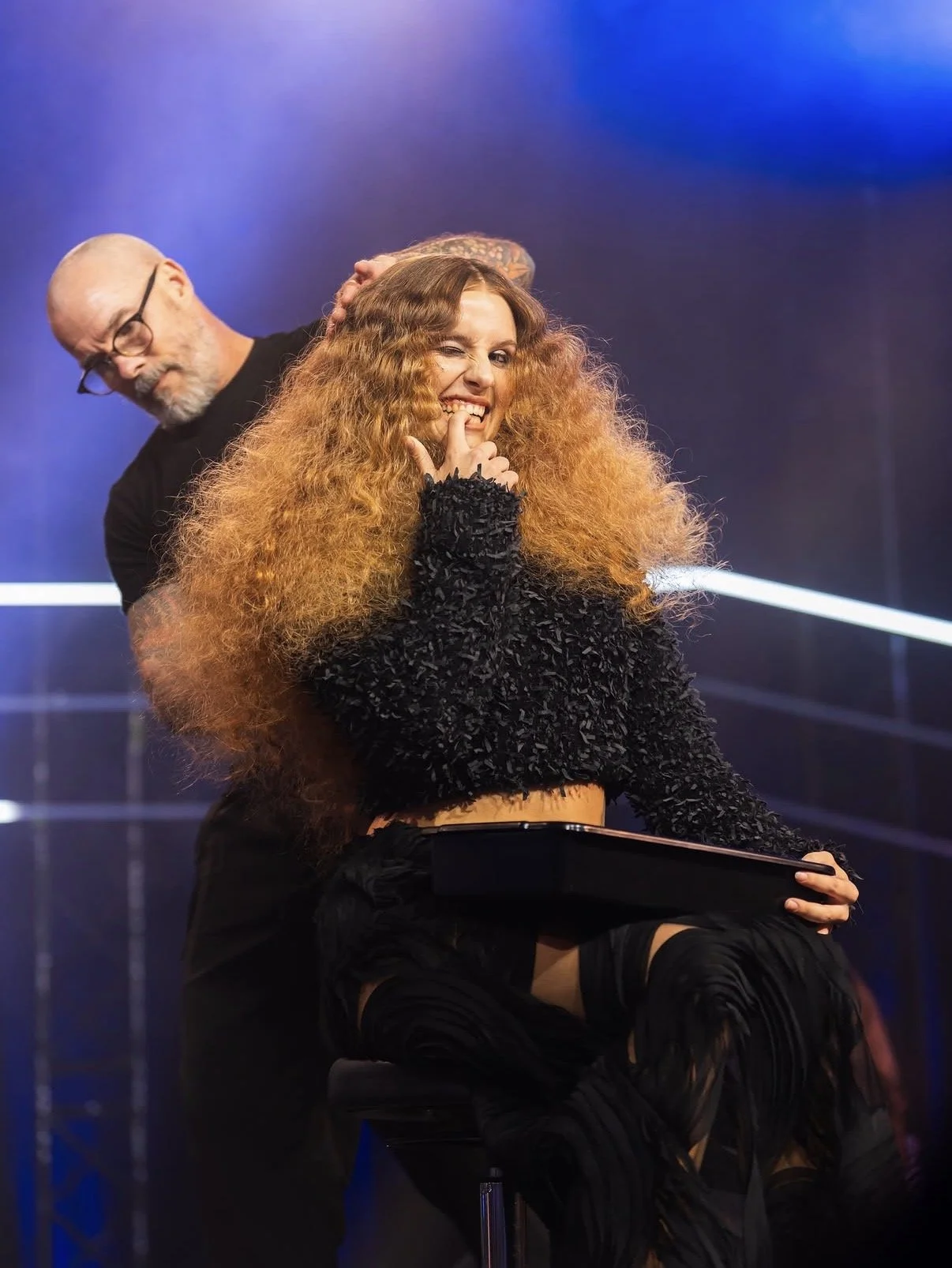
Richard Kavanagh has done hair backstage for Prada, Marc Jacobs and Ralph Lauren. Ask him which product to use, and he'll ask you a question back.
What hair are you starting with?
This is Part 2 of our chat. Part 1 was his career story. This Insider Edit is every tool, every product and every trick he shared. If you're a makeup artist who does hair, save this one.
How Richard picks product
Harder or softer?
Richard thinks of hair as a canvas. Before he reaches for anything, he asks one question. Do I want this hair to feel harder or softer?
Harder hair holds shape. Softer hair moves. Some looks need both in different parts of the head.
Read the back of the can
"We don't read the front of the can, because the front of the can is for consumers."
Richard reads the ingredients:
Acrylates high on the list: the product will harden the hair.
Silicones and glycerols high on the list: the product will soften it.
He owns a mousse with "volume" in its name that he never uses for volume. It's highly moisturising. He uses it on porous or coarse hair when he wants moisture, definition and a soft, reflective, pliable finish.
Seven products for "no product" hair
Richard's clients mostly book him for hair that doesn't look like a hairdresser touched it. That takes more product than you'd think.
He walked me through a recent "I just woke up like this" look. Seven products:
A lightweight moisturiser
A lightweight volumiser
A little hair oil
A heavier volumiser
A texturiser
and 7. A mix of cream and oil to finish
He doesn't plan it out in advance. He reads the hair as he goes.
Hot tools
An ondulé iron Richard calls this his weirdest tool. He says it's a Canadian thing and you can only buy them second-hand now. It has two prongs that open and close. You weave the hair in and out of the prongs, heat it, then slide the iron out.
The result is a pre-Raphaelite wave. It sits flatter at the top, undulates out and looks really natural once he brushes it out. He uses it more than you'd think, across beauty, hair and fashion campaigns. He recently did this technique on a model on stage at a hair event and brushed her out live. It's on his Instagram.
A three-quarter inch Marcel tong His most-used hot tool for putting a bend in the hair. He uses it for 90s supermodel volume and for easy, effortless lift. He owns a smaller one and three bigger ones, but this is the size he reaches for. He bought it from Alan White's website and isn't sure it's still in stock.
Why a Marcel handle? Richard says it gives a professional more scope for different techniques. A spring or clip handle suits consumers, because it's easier to use.
Brushes
Mason Pearson "Obviously can't live without Mason Pearson." He owns two in different sizes, and both are well worn.
If you heard Part 1, you'll know the Mason Pearson story from his apprenticeship. His boss kept two on her trolley, spotless. One day she found a hair on one and threw it over her shoulder at him. Richard joked that I'd get the same treatment if I ever assist him.
A boar bristle finishing brush from Paris Richard found this one at a little hair supply store in the Passage de l'Industrie in Paris. It's pure boar bristle in African hardwood. The centre bristles are stiff and the outer bristles are softer. Look at it end on and it comes to a peaked point. He uses it for smoothing, polishing and edges. He also told me not to touch it.
YS Park round brushes "The best of the best. That's it." He owns three or four sizes, with a mix of nylon and natural bristle. You can see the wear on his favourite. The nylon still holds, but the natural bristle has divots, so it's due for a replacement.
A note on ceramic brushes Richard doesn't use one. He has tried the brushes from Excellent Edges, a Melbourne company . He says they pair quality Japanese nylon with pure natural boar bristle, on a ceramic and metal barrel that holds heat, with a long pointed tail. He really likes them. They get so hot that he burns himself, so he sticks with his YS Parks.
Pins
Japanese magnetic pin cases He has had these for decades. They have little compartments and a magnetic inside, so the pins stand up and come out easily. Genius.
French U-pins Richard owns traditional bobby pins, but he favours French U-pins. He buys them by the box, half a kilo to a kilo at a time, from the shops in the Passage de l'Industrie in Paris.
What makes them worth the trip:
Strong steel
A ripple along the pin for grip
A soft little bit of silicone on the tips
That silicone matters. The pins you find here are often straight, hard-cut wire, and they scratch the scalp. Richard can't stand the scratchy ones. Once you know how to use a U-pin, it holds. His semi-viral TikTok, a Bardot-inspired half up, half down, uses one pin to hold the whole thing.
The five products Richard can't do without
Richard says he could just as easily name ten, or 20. He layers and layers and keeps his combinations bespoke. These are the five he brought.
1. Redken Root Lifter (formerly Guts) A very high-acrylate, quite dry mousse with a directional spray nozzle. Redken made it as a root volumiser for consumers. Richard sprays it from roots to ends.
You know how easy bleached hair is to style, because it stays where you put it? Spray this on, dry it in, and Richard says it makes hair feel like bleached hair. Perfect prep for an updo.
His warning: people have watched him use half a can on every head at one show, decided that was the secret, then used half a can on hair that didn't need it. Know the hair first.
2. Oscar Oscar Wild Volumising Spray His other favourite volumiser. It's a non-aerosol and super intense. Richard says it's stronger than Guts because it's more concentrated, and slightly less dry. He goes easy with it.
This is his pick for anyone who says their hair always goes flat. He used it on a recent shoot with Celeste Barber, who told him her hair always drops. He says it stayed all day.
3. Fatboy finishing spray His favourite lightweight, invisible finishing spray. Richard says it has a lighter hold than Elnett with a similar finish, and it's brushable.
He uses it when he wants a really polished chignon to look like glass. No comb marks. No brush marks. No pieces. One seamless surface. He uses it on commercial hair for the same reason.
I'd never heard of the brand. I tried it on my own hair during the recording. It smells nice, it feels light and the hair stays easy to work with. I really liked it.
4. Larry King oil Very lightweight and it smells nice. Richard's nearly out of it. He always keeps a pure oil on set. He says it works like an instant moisturiser to close the cuticle and can make hair feel like a seven-year-old's hair. He also mixes oil with other products to soften or dilute them.
5. Moroccanoil Curl Defining Cream It has a little tack in the hand once you rub it in. Richard uses it on dry hair as a finishing product, often mixed with a little oil. It smooths flyaways without flattening the hair, so you keep definition.
By the time he reaches for it, he has usually used five or six products to balance the texture. He blow-dries, bends the hair with a tong, then works this through at the end.
The thing he really can't work without Decades ago, Richard flew to Hawaii for a three-day magazine shoot. He arrived. His kit didn't. He got by with a rubber band and a bit of salt water.
Most hair oils aren't oil
"Most oils on the market are not oil."
Richard says most products that call themselves oil are silicone. Some only contain a little oil for fragrance. Even when the brand name and the product name both say oil, turn the bottle around and read the ingredients.
Silicone isn't bad. It just behaves differently.
Silicones sit on the outside of the hair. They don't absorb.
Oils soak in and make the hair more pliable. They're much heavier, so use a light touch.
Tricks worth stealing
Sea salt spray, then dry shampoo For a lived-in, global traveller texture, Richard puts a bend in the hair first. Then he hits it with sea salt spray. While the spray is still wet, he blasts it with dry shampoo. The powder sticks to the wet salt spray. It takes the clunkiness off and boosts the texture at the same time.
Sea salt spray versus texturising spray Richard describes a texturising spray as hairspray with powder, so it has hold and tack. A sea salt spray relies on salt, so it doesn't have the tacky hold of the acrylate in a hairspray.
Why some hairsprays show up on camera I can see hairspray in my own photos, and I hate it. Richard explained why. Hairspray lands on the hair as tiny sticky spheres. When the spheres come out bigger, they catch the light, and on camera the hair can look dandruffy even when it looks fine to your eye. Other sprays get the water and alcohol ratio slightly off. They leave wet spots and bands, and the hair looks clunky.
Adjust the texture after the light test Light changes how texture reads. Hard light changes it. Backlight shows every flyaway. Richard gets the hair to a point where he can push it piecier or dustier, then adds product after the light test. He still asks for one on every shoot.
For hair and makeup artists: mousse, sprays and wax
This bit is for anyone doing both on set.
I don't use a lot of spray mousses. I'm usually doing hair and makeup and working fast, and I find spray mousses wet the hair and take longer to dry in. I like sprays like the Oscar Oscar because they work fast and I don't have to get my hands dirty. And wax kills me on set. Getting it off my hands before I touch skin takes time.
Richard loves a big handful of mousse. But he's not touching anyone's skin afterwards. He tends to skip waxes too, for a different reason. Once a wax is in, it's in.
Sometimes the delivery mechanism decides it. Pick what suits how you work.
Listen to the full episode
Richard's full kit rundown is on The Insider Edit now, wherever you get your podcasts. Part 1 is his career story, and it's worth the listen.