
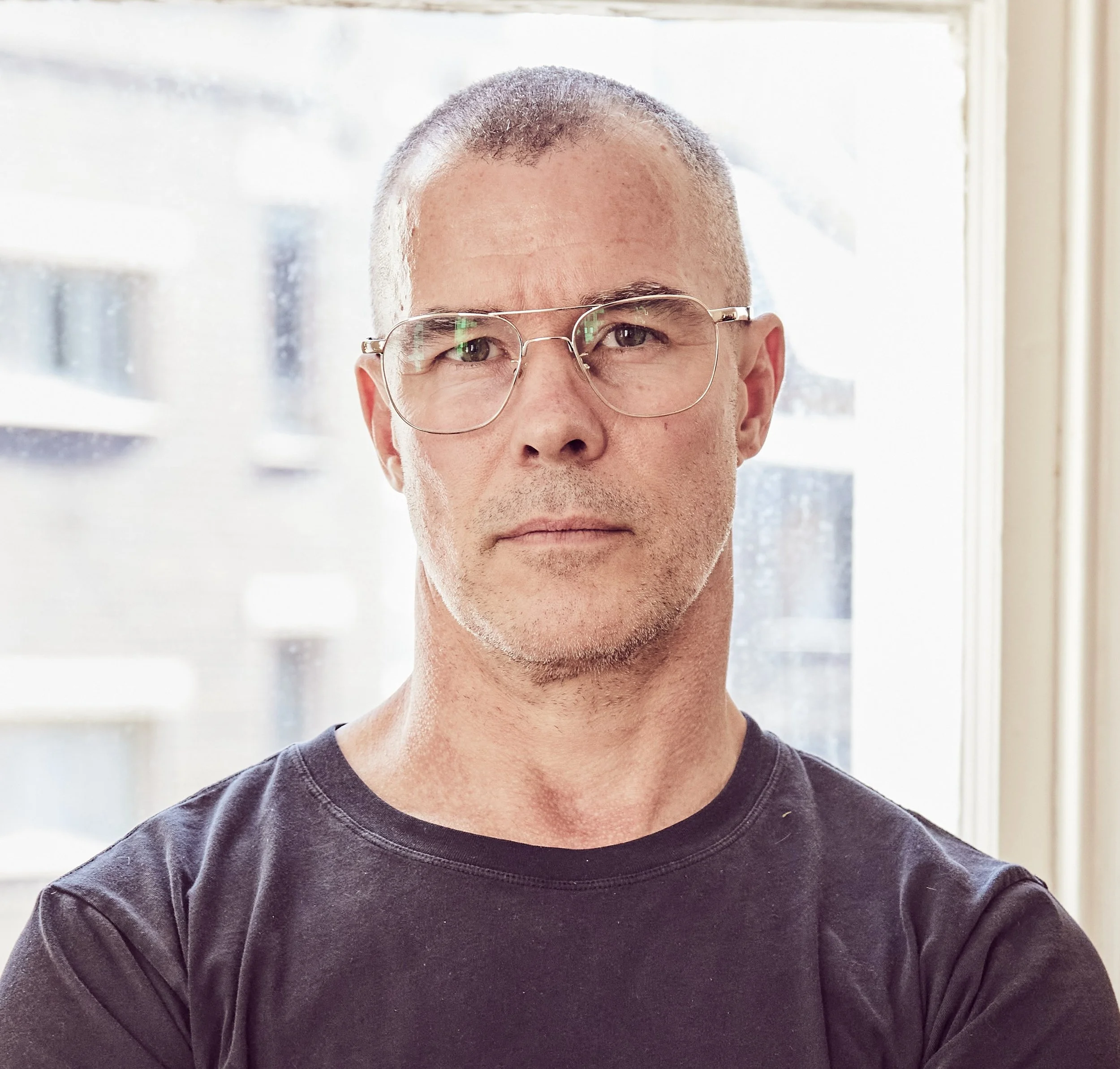
Richards Kavanagh x The Makeup Insider
Richard Kavanagh calls himself an odd jobber.
He's a session stylist. He has also hosted prime time TV, written a book, run a tech company, acted in Hollywood films and coached other creatives for more than ten years. He says yes first and works out the how later.
I met with Richard about two and a half years ago. He took me through his career and I thought, this is a podcast. We finally recorded it, and we talked for so long I've split it in two. This post covers Part 1, his story. His tools and products get their own episode and their own post.
A haircut at 13 decided everything
Richard wanted to be a biochemist. At high school he wanted to do art and sport. He was small, skinny and asthmatic, so the school kept him out of sport. He was academic, so they pushed him into languages and sciences and told him he couldn't do art.
"And so now I've made a life out of art and sport."
Then, at 13, he got a haircut. A wedge underneath, a flat top and a long fringe over one eye. Very Flock of Seagulls. Bright orange underneath, pink and purple tips on top and a green end on the fringe.
While she worked, the hairdresser explained the chemistry of colour: how developer strength lifts the underlying pigment to a specific level, and how you use colour to boost or subdue it. Then she explained the Sassoon method, an architectural approach to cutting an organic fibre into geometric shapes.
Science and structure, in one haircut. Richard says it hit him like a hammer between the eyes. He went home and told his mum he was doing hair.
Door knocking for an apprenticeship
His mum and his teachers wanted him on an academic path. Richard had made up his mind.
At 15, he walked into every salon on the North Shore of Auckland and asked for an apprenticeship. It took about 12 months. He says he looked about ten years old.
A salon called Ashley Brown in Browns Bay gave him a go in 1986. A brother and sister from Manchester ran it, and they weren't even looking for an apprentice.
The sister was a magician with a round brush. Richard says watching her blow-dry was like watching someone whisk whipped cream. She was also strict. She kept two Mason Pearson brushes on rotation and they had to be spotless. One day she found a hair on one and threw it over her shoulder at him.
The brother was all speed. He raced another senior to wind a full head perm. Eight minutes, start to finish.
This was the perm era. A perm and highlights on the same day, with no Olaplex and no K18.
The training ran in strict order. Clean the salon. Gown the clients. Then shampoo, then rinse colours, then apply a basic colour, then highlights and perms. Each skill built the base for the next one.
Gowning clients was the awkward part. Richard was a kid reaching around grown women to tie their gowns. It taught him how to be comfortable with people.
"All we do is so intimate," he says. How many people in your life touch you on the head, for an hour, every month?
Seven years, and a question
About ten months in, Richard found out the salon couldn't sign his apprenticeship papers. Their qualifications were from the UK, and the New Zealand system wouldn't accept them. So he went looking for another salon in the classifieds.
An apprenticeship should have taken three years. His took seven or eight. He calls himself a 15-year-old troublemaker who let life and chaos distract him.
Late in our chat he told me more. For a few years in the middle of that apprenticeship, he lived on the street. He had no address. He ate out of rubbish bins and stole to survive. He says he never forgets it, and it's why he's so grateful for the life this craft has given him.
The turning point came around 1994. Richard was 24. He had trained in martial arts for six or seven years and had his first black belt. He asked himself one question:
"What if I applied the same focus and discipline to my career that I've applied to martial arts? I wonder what could happen."
He looked at the people who had what he wanted. They won awards. They ran successful salons. They taught, travelled and represented brands. His thought was simple: "If he can do it, then why not me?"
Martial arts had taught him that you acquire skill. You watch, you practise, and you find an experienced mentor who can show you your blind spots.
Get in the right room
Richard's first karate teacher was a yellow belt. Within a few months Richard had caught up. Nobody in that room could teach him more, so he went and found the toughest school with the best instructors he could.
"You've got to be in the right room with the right people to acquire the right skills."
He ran his career the same way. He entered every award and every competition, and he won a bunch in the 90s. That led to stages, education work overseas and fashion shows.
I asked him if he's always been a good storyteller, because I notice the most successful people I interview all are. He says no. He learnt it. At school he would turn a page-long story into two sentences.
TV producers coached him. Mentors told him what landed on stage and what didn't. When he did a weekly morning TV segment, the network sent him the tape each week. He watched it back and coached himself.
His first fashion shows were in a local mall. He did every model's hair in a cupboard in the middle of the mall and changed the hair for every look.
"You do makeup as well, right?"
This is the story every makeup artist needs to hear.
Around 1997, a photographer rang Richard with his first editorial job. Four days in Queenstown, three fashion stories and some cover tries. Richard said yes before the photographer finished the sentence.
As they hung up, the photographer said, "You do makeup as well, right?"
Richard said yeah. He didn't want to lose the job.
He had never worn makeup. There was no YouTube and no internet. He went to the makeup shop, bought a bunch of things and flew down. The makeup took him forever.
Then the magazine came out. They got the cover, and the cover was a beauty shot.
Magazine credits were everything back then. Photographers started booking him for hair and makeup. He worked on billboard campaigns and big global brands. About six months in, he felt sick at every shoot.
"It wasn't imposter syndrome. I literally was an imposter."
One day he asked a photographer if they could split the job and bring in a makeup artist. She said she was so glad he'd asked. His hair was fabulous. The makeup, sometimes, was not.
He gave his whole makeup kit to his assistant that day.
His view now: people who aren't on the tools think hair and makeup is one thing. It isn't. "The only way that they're related is by the physical proximity of them being on the person's head."
Makeup artists who do hair will know the other side of that feeling.
Morning TV, a book and New York
A three-minute hair segment on morning TV rated so well that the network asked him back every Monday, for up to 12 minutes. That's about 50 pieces of content a year.
To work out what to cover, he emailed a group of people one question. If you went to a friend's place and found a hair book on the coffee table, what would you hope to find in it?
One person replied, "I want that book. Where is it?" A published author on the list offered to introduce him to the publishers at Penguin Random House.
He pitched it as a recipe book, but for hair. He says he took his inspiration from Donna Hay's books: a few steps, the ingredients and the time required. Each week he wrote the TV segment as a recipe. Each recipe became a chapter. The first print run of 10,000 copies sold out.
He has now bought the rights back, and the book is on sale again as an ebook and print on demand. Love Your Hair.
He also pitched the network on a segment from backstage at New York Fashion Week, translating runway trends for everyday women. They told him to find sponsors. He did. His wife, a photographer, taught him to shoot and gave him a DSLR.
"I'll see you in Milan"
While he was in New York, a friend asked him to help out on a show. Ask for Sandy. Sandy needs some hands.
It was the Diesel Black Gold show. Sandy was first assistant to Guido Palau, who Richard calls the preeminent fashion hairstylist of our era.
Richard did one model's hair and took her to Guido for the tick. Guido looked at her and said, "I want you to go around to every single girl and make sure they all look exactly like that."
So he did. Richard says he takes everything at face value and doesn't see social hierarchies. It didn't occur to him that some of those stylists had spent decades on Guido's team, or how it looked for the new guy to fix their work. He only worked that out years later.
After the show, the man who books the teams told him, "I booked the teams and I didn't book you," and turned his back. Richard packed up and left. The same man came running down the street after him. Guido wanted him for the rest of the week.
Richard's reply? Send me the schedule and I'll see what I can do. He had no idea how many hairdressers were chasing a spot on that team.
He worked more shows that week, including Marc Jacobs and Ralph Lauren. People kept asking if he was coming to Milan. He kept saying he didn't think so. Then Guido gave him a hug and said, "I'll see you in Milan, yeah?"
First show off the plane: Prada.
"That was an absolute pinch me moment for this little kid from New Zealand."
He went on to work around 300 shows with Guido's team over multiple seasons.
What Guido taught him about leading
The first season was tough. Guido put huge pressure on new people. A couple of years later he told Richard why. He's at the top of the game, so the only way is down, and his team's performance is the one thing that could take him there.
Richard learnt a lot from it. He also decided that strict, authoritarian style doesn't work for him.
He breaks a hair director's job into three parts:
The creative. Working with the creative director and the client to come up with the look.
Team leadership. Getting the team to deliver hair that looks as if he did every head himself, and making sure they leave having learnt something and wanting to come back.
Media. Representing yourself, the brand and the designer well.
He stopped travelling with the team as his kids got older. He was away for six weeks, twice a year, every February and September. In 2020, when everything shut, he stayed home, walked his dog and realised he liked it.
Sydney instead of New York
Richard was a long way down the path of moving to New York. He had an agent there, he'd started the visa process and the family had visited schools.
Then he did a shoot in Sydney on a crisp, bright autumn day. Great fashion, great images, great models. The work was as good as his New York work, and at his level the money was the same.
He rang his wife on the way to the airport. Six weeks later they lived in Bondi. That was 2011, and he says it's the best thing they ever did.
Product, books and business
I asked Richard if he has ever thought about making his own product. He hasn't. He has had a book, brushes and hot tools over the years. But he says so many people already make amazing products, and he's not a marketer.
He has spent the last eight years as CEO of a tech company, and one idea stuck with him there. Business is two things: innovation and marketing. Innovation doesn't have to mean something brand new. It can be a better way of delivering something that already exists. Then it's marketing.
"I'm the innovator. I'm not the marketer."
At least he knows what he doesn't like. That's half the battle.
Where makeup artists go wrong with hair
I asked Richard for the biggest hurdle for makeup artists learning hair. His answer: looking for a one-size-fits-all fix. "What product should I use to do this?" is the wrong first question.
Understand what hair is first. Hair is millions of flexible fibres. It's dead. It's keratin. It has three layers: the cuticle, the cortex and the medulla. Richard breaks hair into four primary types, African, Asian, Caucasian and Melanesian, each with a different structure and a spectrum within it. Different types need different tools, techniques and products. (Richard's tools and products are all in Part 2.)
He compares it to skin. You wouldn't look at flaky skin and ask what one product fixes it.
"Understand the hair type before you try and understand the outcome."
Then learn the history of hair. Look at the shapes and textures of each era, and how and why people got them. In the 50s and 60s, people didn't do their hair at home. The salon washed it, set it in rollers with setting lotion and put them under a hot dryer. That's why the hair looked the way it did.
One for anyone who gets a regular blow-dry: ask for a conditioning treatment at the basin. And if you're a hairdresser, offer it. Don't assume your clients know.
Coaching, 200 pages of notes and Scene
Richard has coached creatives for 12 to 15 years. For eight of those he worked exclusively with one salon group of 500 to 600 staff. His private mission was to get them into the industry awards. Over three years the group had winners and finalists in every category of every major award, including Hairdresser of the Year three years running, with a different hairdresser from a different salon each time.
He now coaches about 15 artists one on one. His niche isn't social media or marketing. It's helping a creative find their own version of success, and showing them their blind spots.
Most of the artists he works with are neurodivergent, he says, and many of them tell him structure isn't for them. His answer is that structure isn't rigid. It's "a container to have freedom within". Turn up on time, prepared. Deliver what you promised. Finish on time.
He keeps a notebook for every session and has 15 years of them, written in his own shorthand. Recently he photographed about 200 pages and put them into Claude to look for patterns. About ten principles kept coming up, year after year, with artist after artist.
He turned those into an eight-week group coaching program called Seen.
15 spots
A 90-minute Zoom session each week
Four weeks across October and November, a summer break, then four weeks in February
A structured lesson, homework and group feedback every week
It covers stagecraft, presentation skills, how to structure and run a room, how to earn an audience's attention in the first few seconds, what to do when things go haywire mid-presentation, goal setting and leadership.
Who is it for? Hairdressers, makeup artists, photographers and filmmakers who know their work is good and keep watching other people get the brand deals, the stages and the awards.
Shame, trades and AI
Richard says most limiting beliefs boil down to "I think I can't". The hard part is that they're blind spots. You don't know they're there.
He told a story about a woman he met once, before a wedding. She was an accountant who didn't like being an accountant. Her dream was to own an Airbnb in the South Island of New Zealand. Money wasn't the problem. Her husband wanted the same move. They had even found the perfect property. Richard told her, bluntly, to go and buy it. She said she had never thought she could.
His own blind spot was shame. He had won awards, he was travelling the world and working on the biggest shows. One day he noticed his shoulder lift when someone asked what he did for a job. He sat with the feeling and named it. "That feeling is shame." Once he saw it, it went.
It made sense. His family told him he was much smarter than hairdressing. As a young man in fashionable clothes, he copped abuse from other young blokes all the time.
I told him I carried the same shame about being a hairdresser. In my late twenties or early thirties I wanted to go to uni and study PR because I thought it would make me credible.
Here's where Richard has landed. He thinks AI will automate a lot of the process-driven jobs we used to value most, and that it won't automate personal service trades. Someone told him about a recent private school graduation in the eastern suburbs where more than half the boys were heading into trades. Two years ago, he says, 90 per cent would have gone to uni.
"Our craft is only going to get more valuable."
Every morning this year he has made a coffee, sat on his balcony and listed what he's grateful for. He says the practice keeps showing him where he's been holding back.
His advice: say yes and figure it out
I asked Richard what he'd tell his younger self.
"Give it a crack. You never know what might happen."
That's how he ended up on TV, in films and running a tech company. "Just say yes and figure it out."
Combat sport gives him perspective here. In a fight, a mistake has real consequences. In hair and makeup, ask yourself what the worst outcome is. You do a bad job and a client is unhappy. Zoom out and look at your whole life. We've all had an unhappy client. Move on.
Listen to the full episode
Part 1 with Richard Kavanagh is on The Makeup Insider now, wherever you get your podcasts. Part 2 is his hair kit on The Insider Edit: every tool, his five must-have products and how he reads a can.